September 3, 2026
532 years of double-entry bookkeeping. What if the problem is the protocol?
A friar in Venice
In 1494 Luca Pacioli, a Franciscan friar and mathematician, publishes a treatise on mathematics in Venice. Inside there is a chapter of a few pages describing the method Venetian merchants use to keep their accounts: for every transaction two entries, one debit and one credit, and the books must always balance.
Pacioli did not invent double-entry bookkeeping. Merchants had been using it for at least a century to run the trade between Europe and Byzantium. He wrote it down, and so a local practice became a standard. Within a few decades it spread across Europe. Within a few centuries it became the operating system of every business on the planet.
532 years have passed. We still use it. Not “broadly speaking”: literally. Every journal, every chart of accounts, every trial balance, every month-end close of every company in the world runs on the same protocol a friar documented in the fifteenth century. We have digitised it, scaled it, wrapped it in software that costs billions to maintain. But the logic underneath, two entries per transaction, books that balance, a period that closes and is reconciled, is the same.
It should strike us. In 532 years we have gone from movable type to language models, from sails to rovers on Mars. Yet the way a business understands its own financial reality was designed for an age when the fastest way to send a piece of information was a man on a horse.
Money is information
The explanation, we believe, is that we have always misunderstood what money is. We think of it as a thing: coins, notes, balances. Something you have. But money has been, first of all, an information technology. Every financial instrument in history is a way to encode, transmit and verify information about the economic relationships between people.
A bank transfer is a line of text one bank sends to another. The credit on your account arrives days after that message left. Money moves because someone transmitted the information that authorises the movement.
Faster quills
When ERPs arrived in the nineties and the two-thousands, they simply digitised the protocol of 1494. Faster debits and credits. Electronic books instead of paper ones. Automatic entries instead of handwritten ones. But the information architecture, record the transaction, categorise it, reconcile it, close the period, report, is Pacioli’s. The big ERPs are very sophisticated implementations of a Venetian manual from five centuries ago.
And every piece of financial software built in the last thirty years has worked within those constraints. Expense management exists because the company cannot see what people spend until the information comes back through receipts and approvals. The purchase-to-pay cycle exists as a process because invoices have to be matched to orders by a human eye before payment is authorised. The month-end close takes days because reconciling information scattered across disconnected systems requires people to find and resolve the discrepancies accumulated over thirty days of incomplete flows.
All of this, every role, every process, every approval chain, is information routing. People moving financial data from where it is born to where it must be verified, categorised, approved and recorded. A protocol built around a human limit: the speed at which we process information.
The protocol is the limit
What happens when financial information can be processed, verified and used without people in the loop?
That is the question Ditta was born from. The bookkeeping of an Italian SMB is made of exactly this routing: the invoice lands in the tax mailbox, the transaction lands in the bank, someone pairs them, categorises them, passes them to the accountant, who records them and closes. Every step is a person copying a piece of information from one place to another.
The first instinct of anyone who builds software is to help those people copy better: a faster accounting system, a clearer screen. But software that helps humans route financial information stays inside Pacioli’s architecture. It optimises the system of 1494 instead of replacing it.
The real question is whether the system should be replaced. We think it should.
How administrative work changes
When a system reads the invoice, matches it to the transaction, checks that it is consistent with the contract and with that supplier’s history, and does so the moment the transaction happens, the month-end close stops being a reconstruction. Invoices are matched, categorised and recorded when they happen, not thirty days later. Control moves to before the money moves, not after. People look at the piece the system cannot resolve with certainty, and decide.
“Closing the books” becomes an expression from another era, like “balancing the chequebook”. There is no close any more: the books are always up to date.
People who work in administration do not disappear. They change trade. Most of an admin office’s time today goes to processing transactions and producing reports on things that have already happened. If a system takes that work, people’s time goes to judgement: what is worth doing, where margin is being lost, which supplier to renegotiate. Nobody chose this job to reconcile spreadsheets at month end. The protocol of 1494 turned capable professionals into information routers. Removing it brings them back to what they were there for.
And the gap widens. Ramp has measured, across the tens of thousands of companies that use its platform, how the revenue of those investing most in AI grows compared with those that do not: since 2022 the former have more than doubled, the latter have kept pace with the economy. They are not tech companies: they are ordinary businesses that adopted these tools before the others.
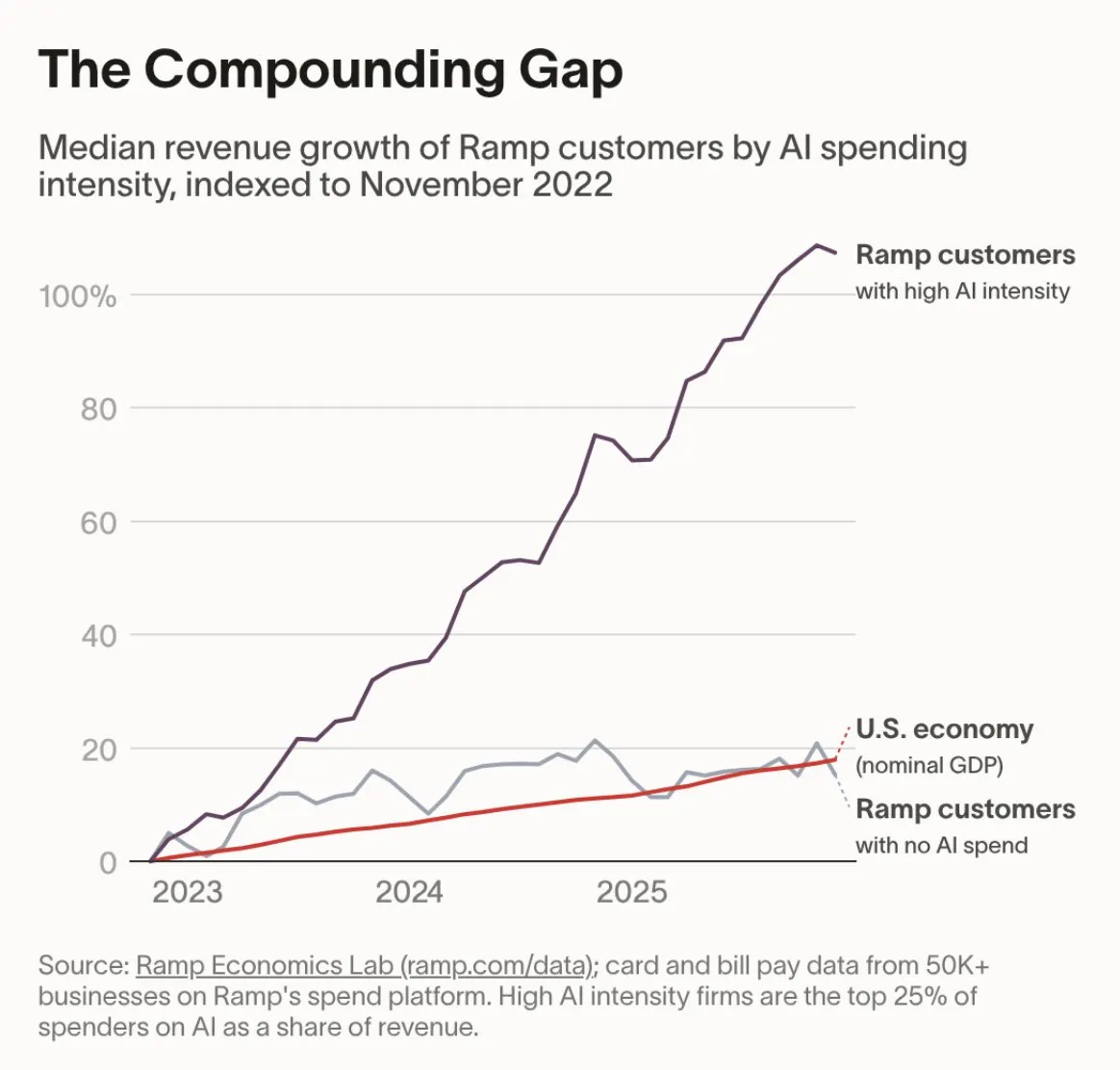
Source: Ramp Economics Lab (ramp.com/data).
No breakthrough required
None of this requires a technological leap. Every component already exists: models that read documents, connections to banks and to the tax mailbox, rules that verify. What is missing is the integration: intelligent systems connected to the real sources, improving with every transaction. It is the work, not an easy one, that we do every day.
For 532 years financial information has passed through human hands, with a protocol designed for quills and paper ledgers. Nobody questioned the protocol: better tools were built on top of it. Today the technology exists to do what those hands did, continuously and without the latency of human routing.
Pacioli gave us a protocol that lasted half a millennium. It is time to close the book.
This article takes up and adapts, in our own words and from the point of view of people who work with Italian SMBs, a piece by Eric Glyman, co-founder of Ramp, published on X under the title “532 Years”.
Image: portrait of Luca Pacioli attributed to Jacopo de’ Barbari, 1495, public domain.